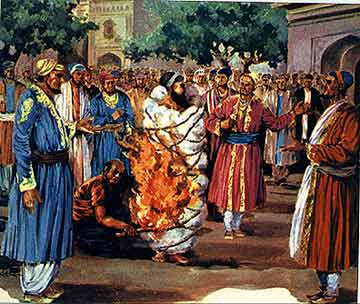
Today, every one of us enjoys basic human rights when we were born. Like what Abraham Lincoln believed, “All men are created equal.” We all deserve a life of our own. However, in India, widows live with an extremely low social status. These Indian widows, the poorest of the poor and some of whom are even very young, are shunned from society when their husbands die. They cannot get remarried. They must not wear jewelry. They are forced to shave their heads and typically wear white. Even their shadows are considered bad luck (Damon, A.).
Desperate to earn enough to survive, those widows are forced to make the pilgrimage to holy cities such as Vrindavan, near Agra, to pray at holy sites in exchange for meals and money. Vrindavan, often called The City of Temples, is a small, dusty town known for its 4000 temples associated with the childhood of Krishna. For more than six hours a day, those widows congregate at the temples. They chant prayers to Krishna in return for two Indian rupees and a meager meal that mainly consists of rice (N.A.). Thousands of India's widows are here mainly waiting to die. They are found on side streets, hunched over with walking canes. Their pain is etched by hundreds of deep wrinkles in their faces.
An interview with an Indian widow revealed how they feel about their miserable lives. "I don’t feel good. Now what I can only do is to loiter just for a bite to eat." said 70-year-old Rada Rani Biswas with a strong voice, but her spirit was broken. When her husband of 50 years died, she was instantly ostracized by all those she thought loved her, including her son. "My son tells me that I have grown old. Now no one is going to feed me. And tells me to go away." she said with her eyes filling with tears. "What do I do? My pain had no limit." As she spoke, she squated in front of one of Vrindavan's temples, and her life was reduced to begging for scraps of food (Damon, A.).
Besides flocking to the holy cities, some of those Indian widows even commit “Sati,” the self immolation of widows on their husband's funeral. They are routinely thrown on funeral pyres alive even though the ritual was outlawed in 1829 by the British (On this day.). Sati is a voluntary act, theoretically at least, meant to atone for the couple's sins and ensure their reunion in the afterlife. But horrified Indian feminists say that in practice the Sati, victims often have little choice. Sometimes family members, including other women, browbeat the widows into it; sometimes the widows are bound or hopped up on drugs. Much of the time even that isn't enough. It's said music is played at high volume during Sati so no one could hear the widow's screams.
The best-known case of Sati in modern times involved the 1987 suicide (or murder) of 18-year-old Roop Kanwar, who was educated, middle-class, and devoutly religious. Kanwar had been married for just eight months when her husband died, apparently from a burst appendix. On the funeral, she put on jewels and her wedding sari, climbed her husband's funeral pyre, cradled his head on her lap, and then commanded that the fire be lit. Before long, she and her husband had been reduced to ashes (Adams, C.). The above mentioned situation and all the cases tell us the plight the widows in India are facing, and there are some reasons leading to the plight.
Here comes to a question that what doctrine or what rule drives the widows in India into such a practice? In stereotype, India is a continent full of gods, taboos, and religious superstitions. The practice, “Sati,” is heavily colored by reiligon that the term is derived from the name of a Hindu goddess, Sati. The practice could be traced to a love story in Hindu mythology. Sati’s father, Daksha, also one of the Hindu gods, disliked her husband, Shiva, who is one of the Trimurti. One day Daksha held a festivity and invited all the gods in the universes, but Shiva and Sati were not invited. Daksha’s ignorance of the great Trimurti was a great humiliation; not only to Shiva, also to Daksha’s own daughter, Sati. Sati argued with her father, and was sad because her unblessed marriage brought Shiva such dishonor. As the result, Sati self-immolated as an act of loyalty and devotion of love to her husband. However, Sati was reborn later as Parvati, the mother goddess, the Divine Mother. She sought and received Shiva as her husband, so that the two loved ones reunite again. (Sati [practice]).
Even though Sati is considered a Hindu custom, the practice was cruel and inhuman. Sati was supposed to be voluntary; but widows were often forced into the practice because the Hindus believe that “a woman who dies burning herself on her husbands funeral fire was considered most virtuous, and was believed to directly go to heaven, redeeming all the forefathers rotting in hell, by this "meritorious" act.”(Dr. Jyotsna Kamat). The practice seems to become less connected with the mythology of Sati and Shiva, but more with redeeming the deceased ancestors. The widows burnt alive receive high respect that they were worshipped as goddesses and temples were built in their memory. In addition, not just the widows in lower Hindu caste; many royal funerals sometimes includes the burning of many wives and concubines of the late royalty. (Aharon Daniel). The honors and redemptions of the dead seem to be more valuable than the lives of living women.
In 1829, Sati practice was banned by the British colonial government. However, there were a few hundred officially recorded rituals every year, and countless ones happened in silence. The most significant was Raja Rammohan Roy, founder of the Brahma Sabha, and other Hindu reformers’ efforts greatly pushed the movement to outlaw the practice. In fact, the custom did not vanish completely even after the ban that it eventually disappeared after few decades. The most recent incidents happens in 1987 that “an eighteen years old widow, Roop Kanwar, committed Sati in a village of Rajasthan. The 'Sati' version is that Roop told her father-in-law she wanted to commit Sati. But Roop was forced to commit Sati.” (Miral Patel and Ekta Bhattarai) The case eventually went to court, but no one was charged to her murder. Even today, Sati practice sometimes occurs in rural villages, the plight of the Indian widows continues in this modern yet traditional, and the most populous democratic country on earth.
Bibliography
N.A. “Town where women pray for survival.” Sunday Telegraph, The (Sydney).
Damon, A. "Shunned from society, widows flock to city to die."2007 <>
“On this day.” Times, The (United Kingdom).
Adams, C. "What's up with those Indian widows who commit Sati?". 2002 <>
Gale Literature Criticism Online
J. Peggs. “A voice from India:an appeal to Britain recommending the abolition
of the practice of burning Hindoo widows.” The Satis' cry to Britain. London :Seely,1829.
Website
Wikipedia, the free encyclopedia. “Sati (practice).” Wikimedia Foundation, Inc.
31 May 2009
Dr. Jyotsna Kamat. “The Tradition of Sati in India.” 1996-2009 Kamat's
Potpourri. First Online: August 15,1997, Page Last Updated: April
07,2009
Aharon Daniel. “Sati - The burning of the widow.” Aharon Daniel, 1999-2000.
<>
Miral Patel and Ekta Bhattarai. “Sati-the Burning of The Widow.”
2000.Indianchild.com.

No comments:
Post a Comment