Monday, June 29, 2009

The Plight of Indian Widows


Today, every one of us enjoys basic human rights when we were born. Like what Abraham Lincoln believed, “All men are created equal.” We all deserve a life of our own. However, in India, widows live with an extremely low social status. These Indian widows, the poorest of the poor and some of whom are even very young, are shunned from society when their husbands die. They cannot get remarried. They must not wear jewelry. They are forced to shave their heads and typically wear white. Even their shadows are considered bad luck (Damon, A.).
Desperate to earn enough to survive, those widows are forced to make the pilgrimage to holy cities such as Vrindavan, near Agra, to pray at holy sites in exchange for meals and money. Vrindavan, often called The City of Temples, is a small, dusty town known for its 4000 temples associated with the childhood of Krishna. For more than six hours a day, those widows congregate at the temples. They chant prayers to Krishna in return for two Indian rupees and a meager meal that mainly consists of rice (N.A.). Thousands of India's widows are here mainly waiting to die. They are found on side streets, hunched over with walking canes. Their pain is etched by hundreds of deep wrinkles in their faces.
An interview with an Indian widow revealed how they feel about their miserable lives. "I don’t feel good. Now what I can only do is to loiter just for a bite to eat." said 70-year-old Rada Rani Biswas with a strong voice, but her spirit was broken. When her husband of 50 years died, she was instantly ostracized by all those she thought loved her, including her son. "My son tells me that I have grown old. Now no one is going to feed me. And tells me to go away." she said with her eyes filling with tears. "What do I do? My pain had no limit." As she spoke, she squated in front of one of Vrindavan's temples, and her life was reduced to begging for scraps of food (Damon, A.).
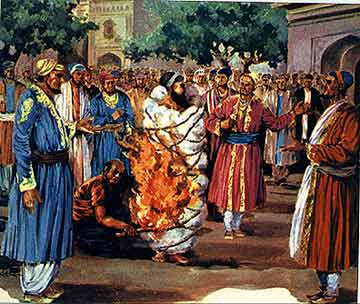
Besides flocking to the holy cities, some of those Indian widows even commit “Sati,” the self immolation of widows on their husband's funeral. They are routinely thrown on funeral pyres alive even though the ritual was outlawed in 1829 by the British (On this day.). Sati is a voluntary act, theoretically at least, meant to atone for the couple's sins and ensure their reunion in the afterlife. But horrified Indian feminists say that in practice the Sati, victims often have little choice. Sometimes family members, including other women, browbeat the widows into it; sometimes the widows are bound or hopped up on drugs. Much of the time even that isn't enough. It's said music is played at high volume during Sati so no one could hear the widow's screams.
The best-known case of Sati in modern times involved the 1987 suicide (or murder) of 18-year-old Roop Kanwar, who was educated, middle-class, and devoutly religious. Kanwar had been married for just eight months when her husband died, apparently from a burst appendix. On the funeral, she put on jewels and her wedding sari, climbed her husband's funeral pyre, cradled his head on her lap, and then commanded that the fire be lit. Before long, she and her husband had been reduced to ashes (Adams, C.). The above mentioned situation and all the cases tell us the plight the widows in India are facing, and there are some reasons leading to the plight.
Here comes to a question that what doctrine or what rule drives the widows in India into such a practice? In stereotype, India is a continent full of gods, taboos, and religious superstitions. The practice, “Sati,” is heavily colored by reiligon that the term is derived from the name of a Hindu goddess, Sati. The practice could be traced to a love story in Hindu mythology. Sati’s father, Daksha, also one of the Hindu gods, disliked her husband, Shiva, who is one of the Trimurti. One day Daksha held a festivity and invited all the gods in the universes, but Shiva and Sati were not invited. Daksha’s ignorance of the great Trimurti was a great humiliation; not only to Shiva, also to Daksha’s own daughter, Sati. Sati argued with her father, and was sad because her unblessed marriage brought Shiva such dishonor. As the result, Sati self-immolated as an act of loyalty and devotion of love to her husband. However, Sati was reborn later as Parvati, the mother goddess, the Divine Mother. She sought and received Shiva as her husband, so that the two loved ones reunite again. (Sati [practice]).
Even though Sati is considered a Hindu custom, the practice was cruel and inhuman. Sati was supposed to be voluntary; but widows were often forced into the practice because the Hindus believe that “a woman who dies burning herself on her husbands funeral fire was considered most virtuous, and was believed to directly go to heaven, redeeming all the forefathers rotting in hell, by this "meritorious" act.”(Dr. Jyotsna Kamat). The practice seems to become less connected with the mythology of Sati and Shiva, but more with redeeming the deceased ancestors. The widows burnt alive receive high respect that they were worshipped as goddesses and temples were built in their memory. In addition, not just the widows in lower Hindu caste; many royal funerals sometimes includes the burning of many wives and concubines of the late royalty. (Aharon Daniel). The honors and redemptions of the dead seem to be more valuable than the lives of living women.
In 1829, Sati practice was banned by the British colonial government. However, there were a few hundred officially recorded rituals every year, and countless ones happened in silence. The most significant was Raja Rammohan Roy, founder of the Brahma Sabha, and other Hindu reformers’ efforts greatly pushed the movement to outlaw the practice. In fact, the custom did not vanish completely even after the ban that it eventually disappeared after few decades. The most recent incidents happens in 1987 that “an eighteen years old widow, Roop Kanwar, committed Sati in a village of Rajasthan. The 'Sati' version is that Roop told her father-in-law she wanted to commit Sati. But Roop was forced to commit Sati.” (Miral Patel and Ekta Bhattarai) The case eventually went to court, but no one was charged to her murder. Even today, Sati practice sometimes occurs in rural villages, the plight of the Indian widows continues in this modern yet traditional, and the most populous democratic country on earth.


Bibliography
N.A. “Town where women pray for survival.” Sunday Telegraph, The (Sydney).

Damon, A. "Shunned from society, widows flock to city to die."2007 <>

“On this day.” Times, The (United Kingdom).

Adams, C. "What's up with those Indian widows who commit Sati?". 2002 <>

Gale Literature Criticism Online
J. Peggs. “A voice from India:an appeal to Britain recommending the abolition
of the practice of burning Hindoo widows.” The Satis' cry to Britain. London :Seely,1829.

Website
Wikipedia, the free encyclopedia. “Sati (practice).” Wikimedia Foundation, Inc.
31 May 2009

Dr. Jyotsna Kamat. “The Tradition of Sati in India.” 1996-2009 Kamat's
Potpourri. First Online: August 15,1997, Page Last Updated: April
07,2009

Aharon Daniel. “Sati - The burning of the widow.” Aharon Daniel, 1999-2000.
<>

Miral Patel and Ekta Bhattarai. “Sati-the Burning of The Widow.”
2000.Indianchild.com.

Wednesday, June 17, 2009

Flip-Flops Rule!

People live a fast paced and open minded live in the modern society. Along with more cultural exchanges and innovations, different life styles and habits of living have spread wide and swift. Many people change their old taste of fashion and join this global trend; but still others could not accept the change. Recently, more and more Taiwanese university students like to wear the New Zealand born “flip-flops” to class, and many has been accused as unsuitable due to various reasons such as not respectable, not cultured, or out of place.

In the traditional Chinese idea, the school is a holy temple, and all teachers are holy men. With all respect, the professors in a university are highly regarded in their fields of expertise; perhaps their morals, too. However, universities, as the holy place of scholastic freedom and academic open-mindedness, should impose no bar nor regulations on how people dress; not physically nor ideologically. In the classroom, professors need to dress up in order to match their social status and pay respect to their profession. On the other hand, students does not have to dress up in order to express their seriousness or respect to the instructors, but by means of academic success and positive learning attitude. Flip-flop is not the issue.

Aside from the traditional point of view, many people state that public courtesy should be kept that no flip-flops should be worn by students who are receiving higher education, especially not in the public place. Such a statement seems correct in which it is noble to be a high class student. However, the word “class” represents the faulty idea of the statement because university students should be unprejudiced in order to receive new ideas or innovate. They should not be labeled in an open academic environment because the campus is not a business conference room where dressing up is an important part of professional image. Students are just blank sheets that deriving and perfecting their academic intelligence for challenges lay ahead of them.

Then comes the issue of proper dressing and the question of why flip-flops is regarded inappropriate in the classroom? There might be answers given out like “you should cover your toes in pubic,” or “flip-flops is jut inappropriate in itself.” Such answers are simply based on intolerable judgments. From the camera lens of American college students, flip-flops is everywhere—in or out of classrooms, and on or off campuses. No one regards flip-flops to be inappropriate; in fact, flip-flops become a mainstream outfit that many girls polish their toes and choose different styles to match the color of their toe nails. Four of the members of the Northwestern Women’s Lacrosse team wore flip-flops while taking a picture with former President Bush in the White House. Since showing toes is considered as stylish and beautiful, wearing flip-flops seems to be a good fashion taste rather than inappropriate.

Embracing the global trend does not mean to forget the good values passed down by our ancestors. Students nowadays respect the instructors, and they expressed it through learning attitudes; and the different opinions or choices should be supported, not suppressed under certain set ideas. Flip-flops should not be discriminated on campus nor labeled as unrespectable and inappropriate dressing style. In fact, flip-flops are everywhere on campus, and no one can stop the trend. Flip-flops rule!

The Man behind Success

When the Boston Celtics won the NBA championship in 2008, the crowd went crazy. When Placido Domingo delivered one more splendid performance, the listeners encored the world famous tenor for another eight beautiful songs. When Yen Chi-Tan defeat ten black belts with stunning martial art skills in the movie “Ip Man,” the audiences were amazed. No one could reach these milestones alone because everyone learns the skills and receives lessons from good coaches: from the mastermind who builds up a basketball team, from the instructor who unlocks the talent of singing, and from the master who inspires the potential of body movement. Besides the expertise of the fields coached, a good coach must care for the trainees personally, pay respect to them, and obtain the passion of the profession.

A coach is not only a drill master, but also a thoughtful friend. On the court, the coach is strict; he will push you to challenge your limit, and will work you so hard until you are out of breath. However, a good coach cares for his team while he is off the court, as a teacher and a friend. My high school basketball coach always invited the team over to his house for barbeque after practices. In that way, he could personally know each one of the team more, paid attention to their needs, and even supported them mentally. He is still a friend of the team even though everyone goes separate ways after graduation.

Other than being a friend, a good coach also pays respect to his trainees. There are coaches who bawl at their trainees all the time, and violate the self-respect of the trainees by demanding absolute submission to them. In fact, a coach is not a slavedriver; obedience does not help trainees in perfecting their skills. Moreover, a coach would never earn respects from his trainees by bawling at them. An adequate coach pays respect to his trainees, leading and directing them on the way to a new professional horizon.

The last and the most important quality of a good coach is his passion for the profession. Without passion, the coach might resign from his trainees before the goal is reached. Without passion, every word of the coach is just another textbook example. Without passion, the coach’s affection of the profession would soon fade out. A basketball coach who lacks passion would not train a champion team. A mentor who dislikes singing would never instruct a world famous tenor. In addition, a master who averts from his teaching would never elevate a disciple so enthusiastic about the art of fighting.

In short, a good coach is not only a professional instructor, but also a teacher who cares, respects, and inspires his trainees. These coaches are behind every Placido Domingo, every Yen Chi-Dan, and every NBA champion. Few could achieve the pinnacle like these world famous people because there are fewer coaches who possess the qualities of being the men behind success than brilliant students.

Wednesday, June 10, 2009

live with style

Fashion is the product of society because people are born to appreciate beauty, and with a heart of competition and eagerness to live a stylish happy life. Channel, Gucci, and Luis Vuitton do not only represent a form of beauty in clothing, accessories, and shoes, they also represent the life style and the spirit of the brand names. Also, successful people want to be different than others and they seek and receive the life style they most agree with. Thus, brands plus admirable people becomes the leading trend and life style in society. People grow up in hopes to become successful, to live a life of pretty, happy, and fashion; people grow up in competitive society to be better than others, to be more distinct from others. The relationship between fashion and society is closely tied together that fashion improves the progress of society, and the progress of society innovates fashion.
Fashion also reflects the root of the society; the ideas and values of the society. In Sex and the City, Carrie has a wedding dress shooting for Vogue, and Carrie changes several beautiful dresses by famous designers. Each dress is different in fashion and serves as a mirror of different fantasies or dreams from every corner of the society. One friend of Carrie says that “right dress” is an important element of a happy marriage. This friend reflects the psychology of the society that choosing the right fashion is as important as choosing spouses. And Carrie herself also believes that with Vivien Westwood dress, the marriage with Big would be blessed. Sadly, fashion does not have such power to promise a lovely ever fairy tale. What fashion does is to fill the wishes by manifestation of images; but fashion does not represent the essence or nature of things.
In short, fashion is the product of society, the engine of progress and the source of innovation. Every era, people add new elements to clothing, and every decade people live to their adored life style with fashion. Fashion influences people’s idea, and thus form the common sense of society. The images of Channel represent the sum of ideas of people who recognizes the value. However, fashion is just an image itself, too. Carrie’s faulty impression of a perfect wedding dress is the best example to distinguish fashion from essence of things. However, those who start fashion also made up the society; thus, society and fashion are closely related to each other.

harry potter?

The movie of J.K. Rowling’s Harry Potter portraits the dark sides of life and social injustices by cruel tortures and bloody rituals of the bad wizards. In Harry Potter series, the social order seems to be verified; in fact, it is violated in some way at the same time.
The protagonist Harry Potter, an orphan who is frequently abused by his relatives and lives a life as a walking dead, finally gets out of the situation by discovering his true identity as one of the special beings with magical power. This power does not come from learning nor hard working; it is “gifted.” And it is an easy explanation that those who suppressed him before are absurd and foolish because they are insensible to the world of magic.
Justice does come to Potter, and when it comes, Potter seems to be reborn into life, and there are people who love and care about him. However, the magical power does not solve Potter’s problem with his relatives, and Rowling seems to promote unrealistic escapes from this problem rather than restore the relationship back to normal, to harmony.
In series five, Order of the Phoenix, the evil force grows, and good guys gets tortured and killed. It is life. In reality bad guys always get advantage of good guys, and people do murder each other for any reasons. Luckily, there is a powerful good guy stand against the evil ones at the end, and temporary drive the bad guys away. Justice comes in and restores the social order back to normal. But this time, justice comes with a message that the bad guys will prevail, and the values the good guys suffer to withhold are questioned.
Although Harry Potter is popular among children, I think Rowling’s work is not suitable for kids because it consists of complicated social injustices and it is not easy for children to distinguish the good from the bad, in which children might be influenced more by the negative issues rather than accepting the bright side of life.

Sunday, May 31, 2009

let it be?


23 years ago, i was born to this world, though not by choice;
20 years ago, i chose to bath by myself while most kids still pee in their pants at night;
17 years ago, i became a nanny of a baby boy, the 1st time i hold bottles for others;
14 years ago, i chose to spend the summer at my aunt's house, and saw the 1st movie in my life;
11 years ago, i chose to trade my summer for cram school, to start ahead for junior high school;
8 years ago, i chose to leave home, leave the place and people i grew up wtih, pursue freedom;
and this is the turning point of my atypical experience that forms me.
4 years ago, after high school, i chose to come home, more precisly, fate called me back;
3 years ago, i chose to move out, took the test, moved my ass here;
2 years ago, i chose to sell my car, broke up with a girl, lost contact with friends; now i have none
last year, the effect of my decisions all comes back...aimless life...such an irony for i have away been planning and counting, making choices and hoping things go my way.
what it comes is everything but what i hope for. i will live up to it, for this was my choice; my life. all the discontents result in my choices; unless, i choose to jump in the current, and let it be.